

BSI_Iscte presents: NOKIA – Human-centric Leadership in a Tech-driven World
BSI_Iscte presents: NOKIA – Human-centric Leadership in a Tech-driven World
On Tuesday, June 23, the BSI_Iscte: Competence Centre Business for Societal Impact hosted an online talk in partnership with NOKIA, Iscte Business School, and BRU-Iscte under the theme NOKIA: Human-centric Leadership in a Tech-driven World, organised by BSI_Iscte’s coordinators Aristides Ferreira and Sandra Costa.
The event brought together academics and industry professionals to explore the theme of human-centric leadership in an increasingly technology-driven workplace. The session was structured around three interconnected panels.
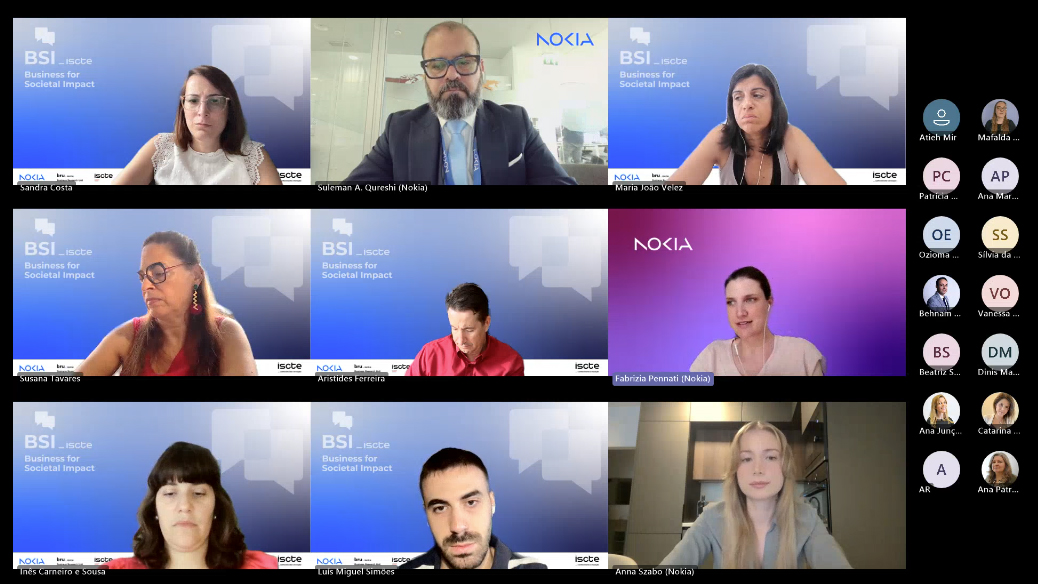
The first panel addressed future leadership competencies in the age of AI, with Iscte researchers arguing that digital fluency, ethical reasoning, trust calibration, and adaptability are now core requirements for leaders. Nokia’s perspective grounded these ideas in practical realities: in a hybrid, AI-enabled organisation, the most critical leadership skills remain trust-building at a distance, clear written communication, psychological safety, and the capacity to navigate uncertainty with transparency rather than false confidence.
The second panel examined diversity, equity, and inclusion in digital workplaces. Iscte panellists highlighted that hybrid and remote work can simultaneously reduce barriers for some groups, such as neurodivergent employees, while creating new forms of exclusion or flexibility stigma for others, particularly those in peripheral roles or with caregiving responsibilities. Nokia emphasised that inclusion is not a stand-alone initiative but a dimension of organisational culture, shaped above all by leader behaviour and the consistency between what organisations say and what they reward. A shared concern across both sides was the risk of visible statements on diversity that are not matched by structural mechanisms such as equitable performance management or deliberate representation in high-visibility opportunities.
The third panel focused on leading hybrid teams, where Iscte speakers raised substantive questions about co-location patterns, subgroup formation, and the invisible inequalities that arise when some team members are systematically more physically present than others. Nokia responded with a clear operating principle: performance is measured by outcomes and delivery, not by presence. Nokia approaches hybrid leadership as a design challenge, establishing shared team agreements, structured communication norms, and intentional inclusion practices rather than relying on informal or proximity-driven dynamics. The session closed with a broader reflection, shared by both institutions, that the fundamental values of good leadership have not changed; what has changed is the intentionality required to enact them across distributed, technology-mediated, and generationally diverse organisations.
The BSI_Iscte Competence Centre is a knowledge transfer centre within the Business Research Unit (BRU-Iscte) in collaboration with the Iscte Business School. It brings together teaching, applied research, and organisational collaboration to co-create solutions for a better society, bridging academia with public, private, and social sector organisations.