
BRU Research Seminar: Ricardo Rodrigues
BRU Research Seminar: Ricardo Rodrigues
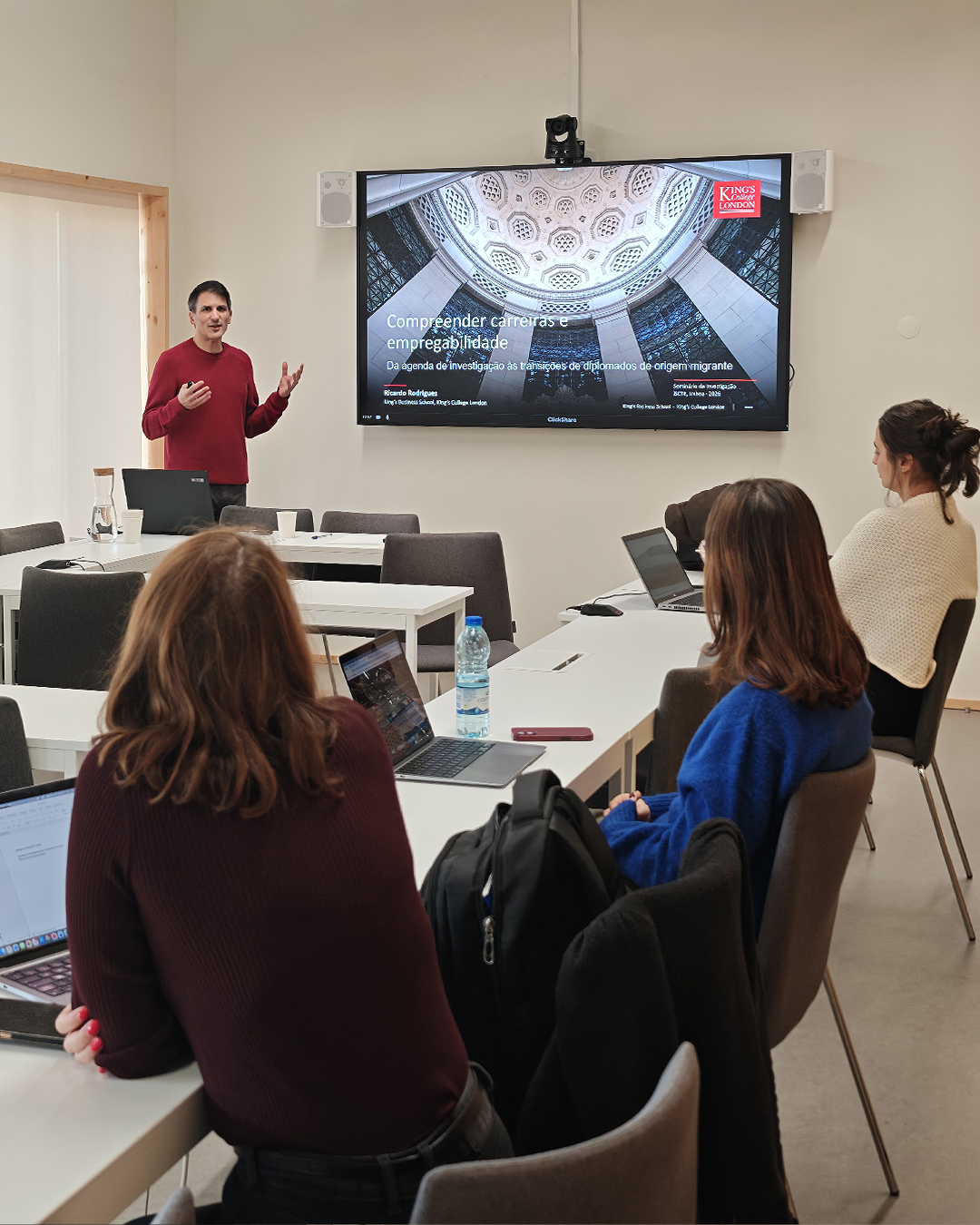
Today, Ricardo Rodrigues, Associate Professor in Human Resource Management at King’s Business School, King’s College London, gave a Research Seminar on the topic ‘Resource Configurations and Migrant Graduates’ Early-Career Transitions: Unequal at the Gateway, Uneven Thereafter?’.
The seminar focused on whether the employment disadvantage faced by graduates with a migrant background narrows or persists over time, drawing on a four-wave study of graduates from a UK university.
The seminar was chaired by BRU-Iscte researcher Patrícia Costa.
Abstract:
Do migrant-background graduates face disadvantage on entering the labour market, and does this disadvantage attenuate or intensify as their careers unfold? Extant research documents both catch-up and persistent inequality, leaving unresolved whose disadvantages endure and under what conditions. Differences in graduates’ resources complicate such comparisons: unequal outcomes may reflect differing starting positions, yet graduates with similar resources may also encounter unequal opportunities. Drawing on conservation of resources theory, we examine whether migrant-background and non-migrant graduates with similar resource configurations experience comparable employment transitions and subsequent career outcomes.
We use data from a four-wave longitudinal study that follows graduates of a single UK university from their final undergraduate year to approximately three years after graduation. Latent profile analysis identifies configurations of family income, parental education, academic attainment and social-network breadth. Within each configuration, we then compare employment entry, employability competences and job satisfaction by migrant background.
At the outset, migrant-background graduates are less likely to enter employment across all identified profiles. Subsequent differences follow contrasting patterns: gaps widen among graduates in more advantaged resource configurations, whereas they narrow or disappear within the profile combining high academic attainment with low socioeconomic resources. Resource advantage therefore does not uniformly buffer against migrant-background disadvantage, nor does a constrained resource position necessarily imply persistent divergence.
The study contributes to employability and career-transition research by examining inequality both within resource configurations and across successive stages of the transition. It highlights the limits of inferring career opportunities from resource possession alone and suggests that catch-up and widening disadvantage can coexist among graduates entering the labour market from different resource positions.